Save resources and money

Energy Management Consultation

From Analysis to ISO 50001 Certification

Your Comprehensive Solution for Sustainable Energy Management

Energy efficiency is more than just software—it’s a strategic process. We guide you every step of the way, from the initial assessment and development of a customized measurement plan to successful ISO 50001 certification. Our holistic approach includes:

  • Strategic Analysis: Together, we analyze your energy flows, identify the largest consumers, and uncover optimization potential.
  • Measurement Concept Development: We define where measurements are needed, how they should be taken, and how data can be optimally collected and transmitted.
  • Technical Implementation: From sensor technology and data connectivity to visualization—we provide the complete technical infrastructure.
  • Ongoing optimization: Through regular data analysis and consulting, we ensure sustainable energy savings.

From the initial audit to certification—your partner for efficient energy management.

Why is strategic energy management important?


  • Ecology: Reducing energy consumption leads to a reduction in CO₂ emissions and supports the fight against climate change.
  • Economy: Energy is a significant cost factor in production. Efficient use can reduce energy consumption and thus costs.
  • Tax advantages: EEG, Electricity Tax Act
  • Competitiveness: Companies that consume less energy can offer their products at lower prices and remain competitive.
  • Legal obligations: Laws and regulations such as ISO 50001 (energy management system) require companies to introduce energy management strategies.
  • Sustainability: Many companies have sustainability goals that are easier to achieve with efficient energy management.


Plant operators and energy and resource managers at manufacturing companies ask themselves the following questions regarding energy management:

  • How do energy flows work?
  • What are the biggest energy consumers?
  • When and where do extreme values occur?
  • What influencing factors are there?
  • What is the ratio of energy consumed to energy generated?

We provide the answers with graphical data analysis. On this basis, we identify potential savings and derive measures.

For the technical implementation, we use our KRIS Energy Management Software, which offers all the features needed for data collection and visualization.


How can efficient energy management be implemented?

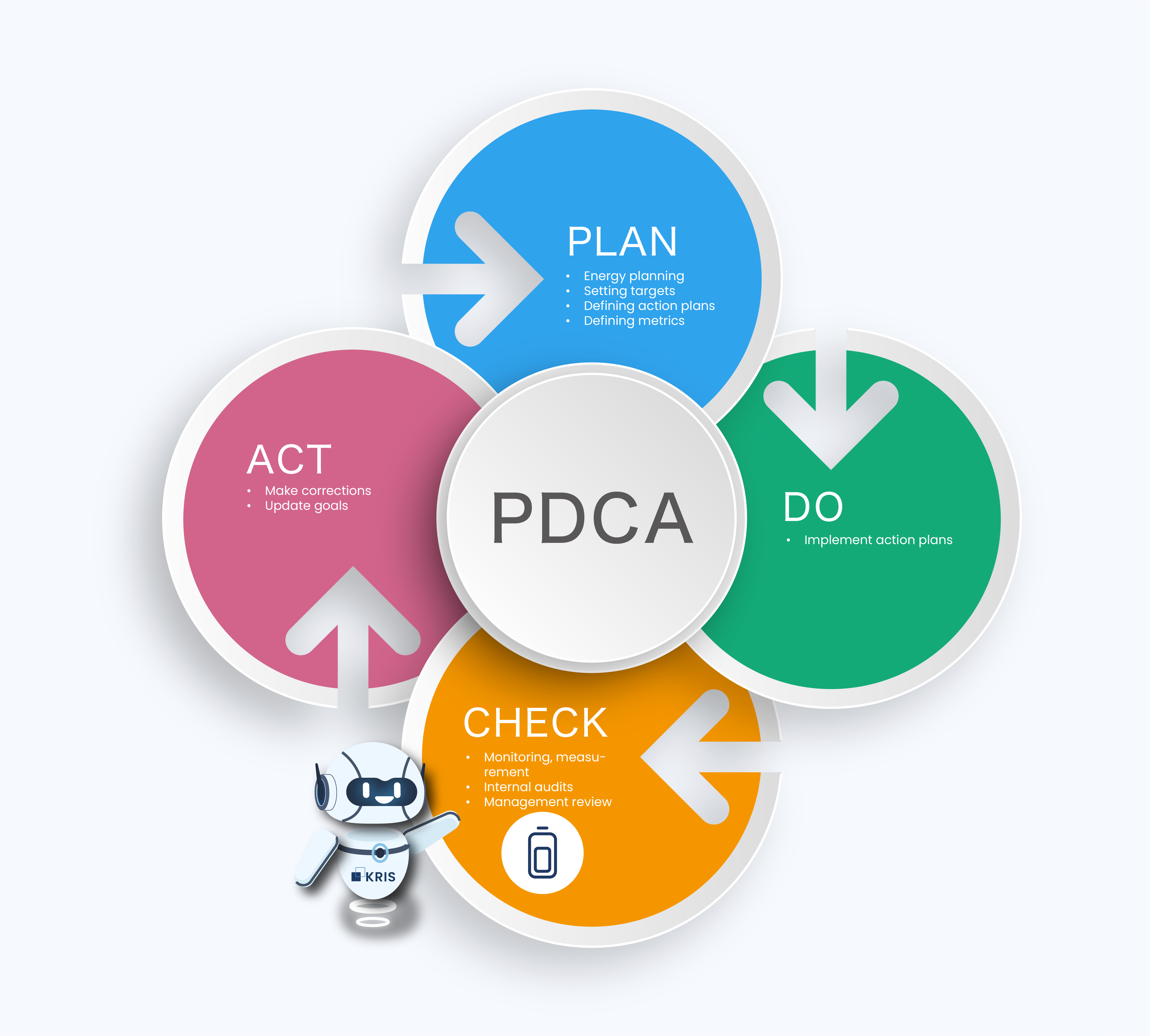
KRIS and PDCA 

The PDCA cycle (Plan-Do-Check-Act), also known as the Deming cycle, is a central element of the energy management system according to ISO 50001. This iterative cycle supports organizations in systematically improving their processes. It ensures that the ISO 50001 energy management system is continuously monitored, evaluated, and improved. This helps to systematically reduce energy consumption, increase energy efficiency, and achieve sustainable energy savings.

The cycle is divided into four phases.

1. Plan

The goal of the first phase is to define the energy policy, set energy targets, and collect relevant data.

  • Measures:
    • Analyze energy consumption (e.g., through energy audits and energy monitoring).
    • Identify energy saving potential.
    • Formulate energy targets and action plans.
    • Define responsibilities.

Example:

A company notices that electricity consumption in production is particularly high. Energy data is collected and analyzed. The goal is to reduce electricity consumption by 10% within one year. As a measure, old machines are replaced with more energy-efficient models, and load management is introduced.

2. Do

The goal of the second phase is to implement the planned measures to improve energy efficiency.

  • Measures:
    • Installation of efficient technologies.
    • Training of employees.
    • Introduction of energy management software.
    • Implementation of energy-saving projects.

Example:

In our example, the new machines are installed. An energy monitoring system is introduced and employee training on energy-efficient behavior takes place.

3. Check

The aim of the third phase is to evaluate the results of the measures and compare them with the targets.

  • Measures:
    • Monitor energy performance indicators (EnPIs) with energy monitoring
    • Analyze deviations.
    • Conduct internal audits.
    • Create reports.

Example:

The consumption data of the new machines is evaluated. The evaluation shows that electricity consumption has already fallen by 7%. Further optimizations are examined (e.g., through better utilization).

4. Act

The aim of the fourth phase is to use findings from the review to improve processes.

  • Measures:
    • Initiate corrective measures.
    • Adapt processes.
    • Update energy targets.
    • Conduct management review.

Example:

The new processes are incorporated into the operating instructions. Further measures are planned, e.g., optimization of lighting or heat recovery. A new PDCA cycle is started to achieve further savings on an ongoing basis.


We offer complete solutions

Our Services in the Field of Energy Management

Bestandsaufnahme

Assessment

  • Joint on-site assessment of the measuring equipment
Konzept

Development of a Measurement Concept

  • How is the data transferred?
Einrichtung

Setup

  • Delivery and setup of the entire energy monitoring system
  • From the sensor to the finished graphical evaluation
Analyse

Analysis

  • We also support you in analyzing the data
  • Identify savings potential through graphical analysis
  • Fact-based

Do you need support with your project? Contact us now! We look forward to hearing from you!

Or book a free initial consultation directly.

Your direct

Contact Persons